Murmur
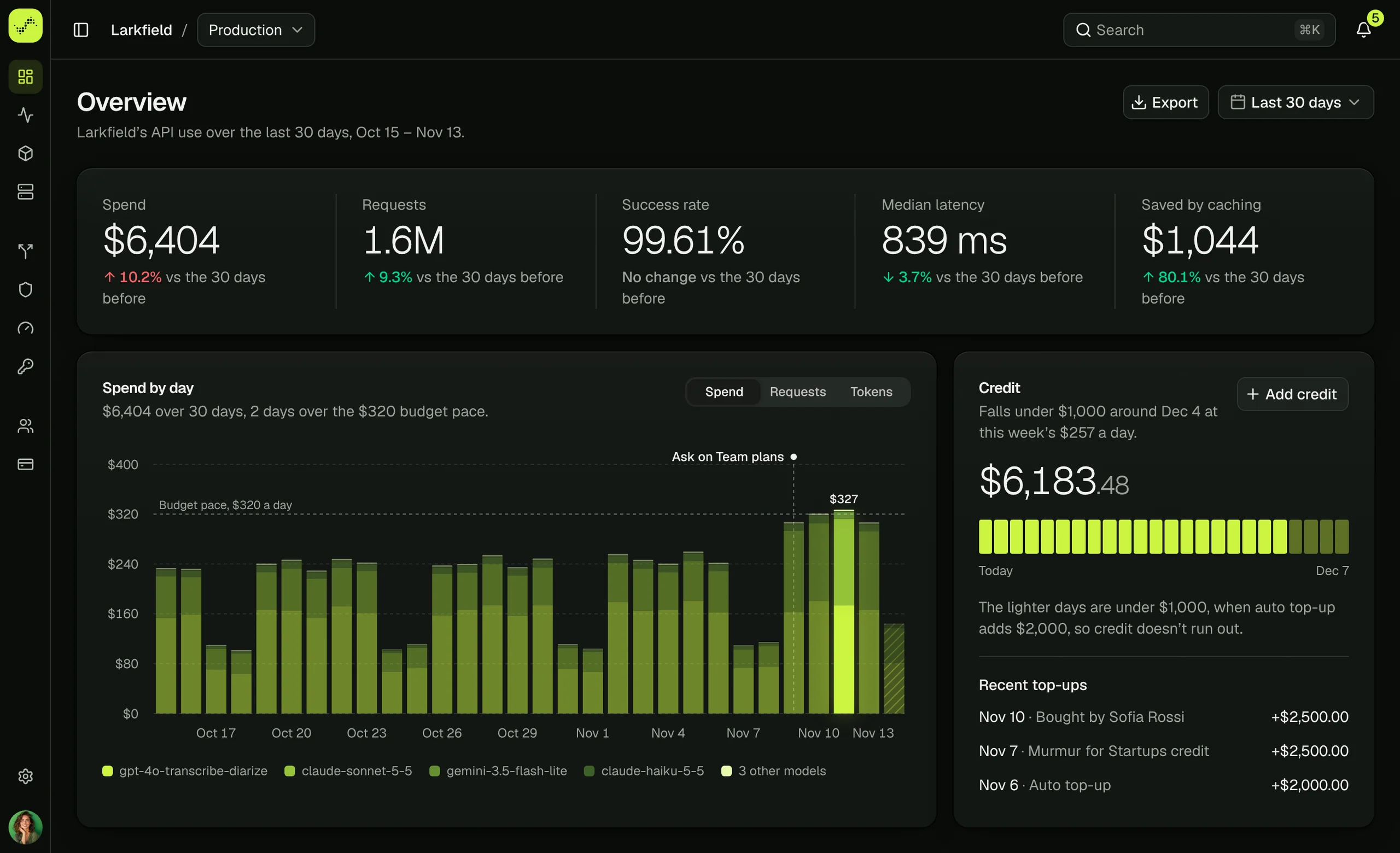
A console for a model API or LLM gateway. What each model, key and customer costs, every request and why it failed, the routes and guardrails each call passes through, and the budgets and credit that keep it in hand.
- Pages
- 19Overview, Requests, Models, Providers, Routing, Guardrails, Budgets, Keys, Customers, Billing and Settings, with a page for each invoice and webhook.
- Roles
- 3Owner, admin and member.
- Component libraries
- 3Base UI, Radix UI or React Aria.
- Icon libraries
- 5From Lucide to Remix Icon, swapped on install.
Pages
Each opens in the live preview, on the sample data.
- Overview (opens in a new tab)
- Requests (opens in a new tab)
- Models (opens in a new tab)
- Providers (opens in a new tab)
- Routing (opens in a new tab)
- Guardrails (opens in a new tab)
- Budgets (opens in a new tab)
- Keys (opens in a new tab)
- Customers (opens in a new tab)
- Billing (opens in a new tab)
- Invoice (opens in a new tab)
- General (opens in a new tab)
- Members (opens in a new tab)
- Single sign-on (opens in a new tab)
- Data policy (opens in a new tab)
- Webhooks (opens in a new tab)
- Add an endpoint (opens in a new tab)
- Webhook endpoint (opens in a new tab)
- Audit log (opens in a new tab)
What you get
The whole app as source in your project, ready to wire to your own data.
Route files for Next.js
Each page is a server component that loads its data, with a loading state while it does.
One sample API
lib/murmur/apiholds typed async functions over a sample workspace’s requests, models, providers, keys, customers, budgets and credit. Rewrite their bodies for your gateway’s logs and billing and the pages stay as they are.Real models at real prices
The sample calls current models from OpenAI, Anthropic, Google and six more makers, at their published prices and with their logos, through their own APIs, Bedrock, Vertex AI and Azure.
Writes that work
Route and guard each call, create, limit and revoke keys, set budgets and customer caps, buy credit, and manage members, single sign-on, the data policy and webhooks. The audit log records every change.
Made of the blocks
Every part is a Dashboardblocks block that installs with it, in your shadcn style, component library and icon set.
Install Murmur
Murmur comes with All-Access and installs with the shadcn CLI, in three steps.
Add the registry
Add
@dashboardblocks-proto theregistriesincomponents.json. Keep thewww: a redirect to another host drops the token.components.json { "registries": { "@dashboardblocks": "https://www.dashboardblocks.com/r/{style}/{name}.json", "@dashboardblocks-pro": { "url": "https://www.dashboardblocks.com/r/pro/{style}/{name}.json", "headers": { "Authorization": "Bearer ${DASHBOARDBLOCKS_TOKEN}" } } } }Add your token
Create a token on your account page and put it in
Create a token.env.local, next tocomponents.json. In CI, set it as a secret instead..env.local DASHBOARDBLOCKS_TOKEN=dbp_…Install Murmur
Run it in a new Next.js 16 project from
shadcn create. It adds every page and the blocks they use. Then runnpm run devand open/overview.Terminal npx shadcn@latest add @dashboardblocks-pro/murmur-next --overwrite